NTN, 2007: What the New Norm Actually Changed
Chronicles the arrival of the New Telemark Norm in 2007 — the dimensional differences from 75mm, the rotational-release mechanism Rottefella built around it, and the binding landscape it split. Draws on Rottefella's published specifications and the subsequent adoption timeline.
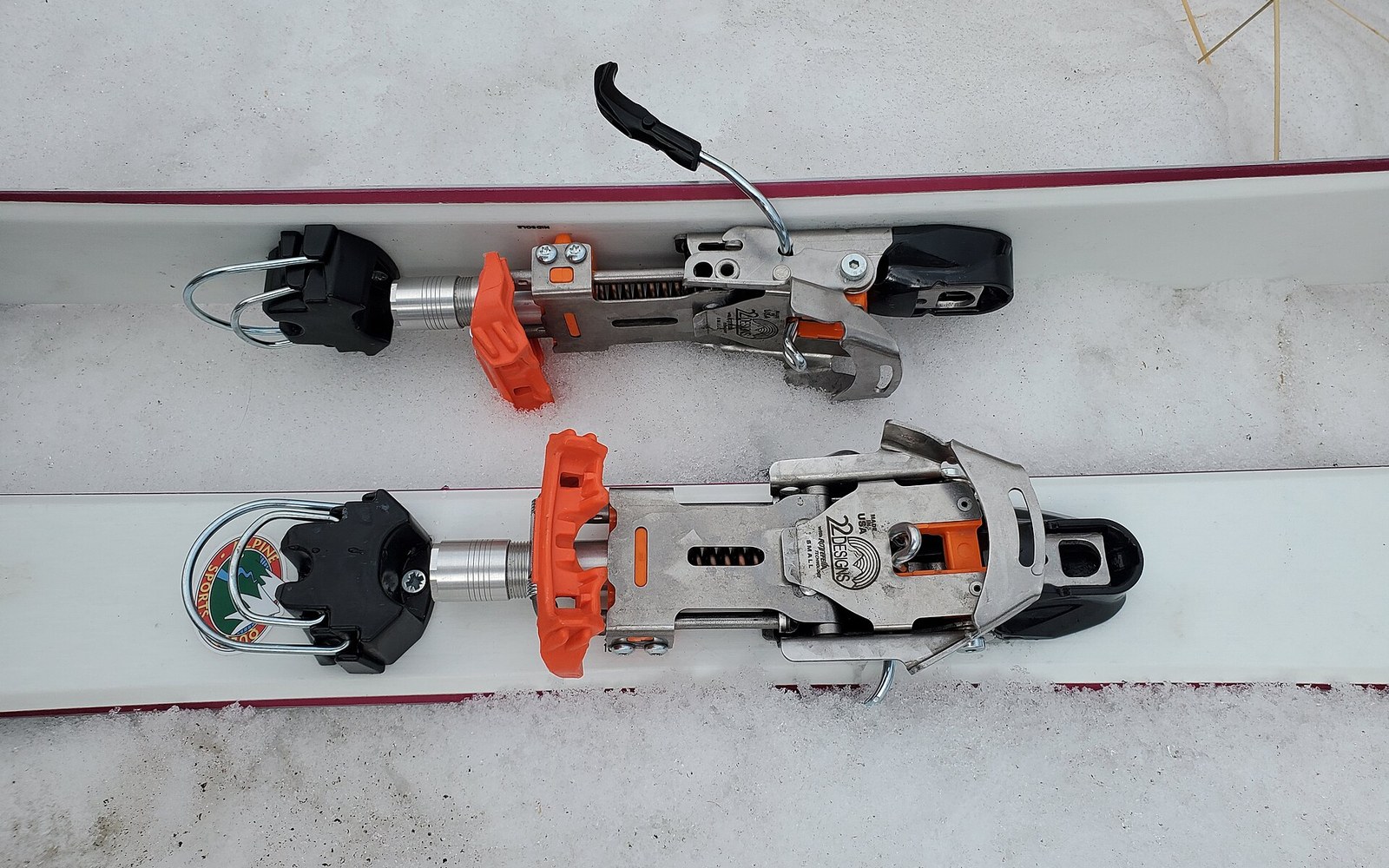
No duckbill: the binding grips a flange moulded under the bellows instead.
Photo: NTN Telemark Bindings · Wikimedia Commons
A new sole standard arrived quietly, then rearranged every corner of the equipment market.
A Different Geometry
The 75mm three-pin duckbill had governed free-heel skiing for decades before Rottefella published the New Telemark Norm in 2007. The 75mm three-pin duckbill — that roughly 75mm-wide toe extension derived from Nordic touring origins — was never an engineered-for-alpine solution. It was inherited, accommodated, and endured. NTN was the first time anyone had designed a telemark interface from the mountain down rather than from the Nordic tradition up.

One binding, laid out. Free-heel hardware is assembled in batches small enough to fit on a cloth.
Photo: Dj Shiflet / Pexels
The dimensional shift was substantial. Where the duckbill extended forward of the boot sole as a flat ledge that slid under a binding bail, the NTN sole presented a different contact geometry entirely. The NTN toe box is wider and taller, with a defined forward lip and a shaped recess, and the sole carries a heel-engagement surface that the 75mm system lacked altogether. The two systems share no components and no boots. A skier moving to NTN needed a new boot, a new binding, and a new expectation of what the interface could do.
Rottefella, the Norwegian company that had long made the dominant three-pin bindings, was not abandoning its heritage when it created NTN — it was responding to a performance ceiling that the old interface had plainly reached. Alpine ski boots had grown stiffer and more precisely fitted through the 1990s; telemark boots were trying to follow, but the duckbill sole placed a hard constraint on how much forward-flex stiffness a boot could deliver before the toe extension became the weak point. NTN moved the load path. The sole engagement wraps the front of the boot rather than pulling on a projecting ledge, distributing force across a larger surface and allowing boot manufacturers to stiffen the shell without the duckbill becoming a structural liability.
Chronology
- 1970s onward75mm three-pin duckbill governs telemark equipment
- 2007Rottefella publishes New Telemark Norm; NTN Freeride binding launches alongside it
- Early 2010sNTN adoption rises in race circuits; backcountry adoption slower
- Mid-2010s22 Designs Outlaw, then Outlaw X, bring cable-architecture thinking to NTN
- Late 2010s–presentboot field expands; tech-toe compatibility developed by The M Equipment and others
- —Both NTN and 75mm systems remain in active production as of 2025
The Release Mechanism, and Why It Mattered
The most consequential change NTN introduced was not dimensional — it was the rotational-release mechanism. No binding meeting the 75mm standard had ever been designed around a genuine release function in the downward and rotational planes simultaneously. The old cable bindings tensioned the boot from the rear and could be shimmed and tuned for feel, but they were not release bindings in any meaningful safety sense. Injuries tracked to telemark equipment carried a different pattern than alpine injuries precisely because the interface held regardless of the load applied to it.
NTN's specification made rotational release a designed-in requirement rather than an afterthought. Rottefella's own published specifications describe the norm as incorporating a defined release function, and the binding that launched alongside the standard — the Rottefella NTN Freeride — was built around that mechanism from the start. The toe piece engages the NTN sole's forward lip while a heel component closes the circuit; under sufficient torsional load, the system releases. This was a structural argument, made in hardware, that telemark skiing had grown complex and aggressive enough to warrant the same category of protection that alpine skiers had taken for granted since the 1970s.
A bin of machined parts is roughly one production run at this volume.
Photo: Daniel Smyth / Pexels
The release geometry also enabled a second development that would take years to fully unfold: partial compatibility with alpine touring tech-toe fittings. Because NTN's toe interface shares dimensional logic with pin-and-socket AT systems, subsequent binding designs have been able to bridge the two worlds — an avenue the duckbill sole closed entirely. That compatibility argument has driven significant engineering effort from makers including The M Equipment, whose Meidjo binding took the tech-toe interface further than Rottefella had.
The Split It Caused
When NTN arrived, it did not replace 75mm — it divided the market. That division has persisted for nearly two decades and shows no sign of fully resolving. In 2007, there was effectively one NTN binding and no NTN boot other than Scarpa's initial offering. Skiers committed to a standard that had minimal product behind it, on the promise that the hardware would follow. For several years it did not follow quickly enough for many buyers, and the cable-binding tradition — anchored by makers like Voile in Salt Lake City — continued to sell steadily to skiers who preferred the known quantity.
The release geometry also enabled a second development that would take years to fully unfold: partial compatibility with alpine touring tech-toe fittings
The adoption timeline was uneven by geography and discipline. Racers moved toward NTN relatively early, because the standard's stiffer engagement and release function aligned with what competitive telemark skiing demands: precise force transfer through the drop-knee position and the lead change, without the binding becoming the limiting factor in the system. The US Telemark Ski Association and the race circuit it governs saw NTN penetration increase measurably through the early 2010s. Backcountry travelers were slower to convert, partly because the added weight of early NTN bindings was real and partly because the release function — genuinely useful in resort and race contexts — was of ambiguous value on low-consequence touring terrain where cable bindings work well and weigh less.
Boot manufacturers shaped the timeline as much as binding makers did. Scarpa committed early and has built out a substantial NTN boot line, including the TX Pro. Crispi followed. But for several years the boot options were narrow enough that a skier with a wide foot or specific flex preference had limited paths into the system. The bellows construction that allows a telemark boot's shell to flex while remaining mounted to the ski is harder to engineer in a stiffer NTN shell than in the old duckbill format, and the first generation of NTN boots was criticized for flex characteristics that did not match the binding's promise. That engineering tension has been substantially resolved in later iterations, but it delayed broad market acceptance through the 2010s.
22 Designs, based in Driggs at the base of the Teton Range, approached NTN from a different angle than Rottefella. The Outlaw — and later the Outlaw X — offered an NTN-compatible binding built with a cable-tension architecture, a mechanical philosophy closer to the old tradition even while meeting the new sole standard. That design decision acknowledged that the cable-binding culture was not going away and that NTN adoption would succeed faster if it could speak to buyers who already trusted the feel of a cable system. Bishop Bindings, the small-batch maker behind the BMF, has occupied a similar space — committed to the NTN interface, opinionated about the mechanical execution.
What NTN changed, in the end, was not just the shape of the sole. It changed what telemark equipment is allowed to claim. A binding meeting the NTN specification can be designed with real engineering intent around safety and performance; a boot built to the standard can be made genuinely stiff without the duckbill acting as a structural fuse. The split between NTN and legacy 75mm gear is sometimes described as a generational divide, and there is truth in that framing: the two systems embody different assumptions about what free-heel skiing is for and how seriously its equipment should take alpine performance as a reference point. The Wikipedia article on telemark skiing ↗ situates the discipline's equipment evolution in that broader context. Nearly eighteen years after the norm's publication, both systems remain in production, both have advocates, and the argument is still live.